How to Apply Liquid Rubber
Liquid rubber has gained immense popularity within the construction industry, from roofing to waterproofing due to its flexibility, durability and its ease of application. Liquid rubber forms a flexible membrane to surfaces that are dry and clean, providing complete protection against moisture and corrosion. In order to achieve a professional finish it is important to realize that application is just as important as the product itself. Preparing the surface correctly, mixing the product at the correct ratio and allowing it to cure in the right conditions are all key to a long lasting coating.
What Is Liquid Rubber and Why Is It Used?
Here is a brief guide to the main uses of liquid rubber sealant before we go on to look at some of the methods for using liquid rubber. The range of uses for liquid rubber has expanded from industrial sealing in recent years to include protection in a variety of situations across different sectors.
Composition and Core Properties
Liquid rubber coatings are made from elastomeric polymers. After the coating has been applied and dried, it becomes a tough and flexible cover. Liquid rubber coatings are suitable for use in all weather and can be applied to a variety of different structures and surfaces, including building roofs and foundations. The coating is elastic and does not become brittle in cold weather. The dried layer is resistant to UV radiation and to chemicals and remains firmly attached to irregular surfaces.
Common Industrial Applications
Liquid rubber is used by professionals in roofing, pond liners, vehicle undercoating and foundation sealing. The liquid forms a continuous waterproof layer with no seams. This means there are no weak points for water to leak through or for corrosion to start.
Advantages Over Traditional Coatings
As opposed to bitumen-based or acrylic coatings, liquid rubber is applied without the need for any heating. Moreover the emission of volatile compounds is minimal. Cold application leads to considerable reduction of fire hazard on site and facilities easy maintenance as new layers can be applied directly on top of existing coatings.
How Should the Surface Be Prepared Before Application?
The surface preparation of a substrate before coating has a massive impact on the coat’s ability to adhere to it. Any contamination on a substrate, be it fine or coarse, will impede the coatings ability to adhere to it properly and may even result in the coating failing prematurely.
Cleaning and Degreasing Procedures
All surfaces must be free of dirt, oil, rust or old paint. If you’re working with metal or concrete, this can be achieved by pressure washing the surface followed by wiping down with solvent. If you’re working with a porous surface such as wood or masonry, make sure that the surface is completely dry before painting.
Repairing Cracks and Irregularities
Any cracks wider than 2 mm must be filled with an appropriate filler prior to coating with liquid rubber. On roofs and tanks, joints should be reinforced with structural fabric as part of the first coat to prevent subsequent cracking due to movement.
Priming Requirements for Different Substrates
Some substrates are coated with a primer to increase the bond between coating and substrate. There are many types of primers. Most are used on porous surfaces but on smooth surfaces such as old painted metal or old concrete and non porous surfaces an epoxy-based primer is a popular choice.
Which Tools and Equipment Are Needed for Application?
The right plastering equipment will allow for consistent wet film thickness & complete surface coverage.
Manual Tools for Small Projects
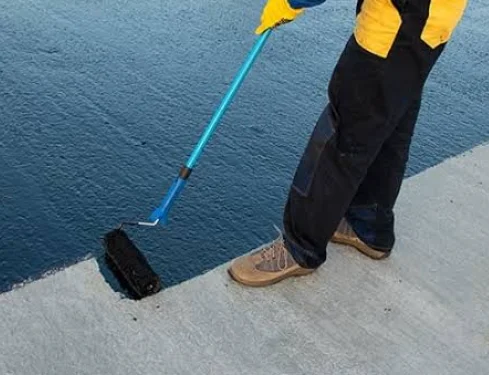
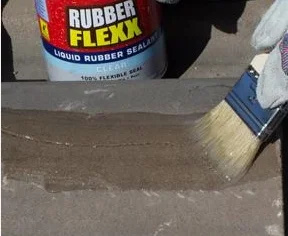
For small-scale applications like waterproofing of balconies or of isolated damage areas, a roller and brush are the better choice. As opposed to spray systems, with a roller and brush one has better control on edges and corners than e.g. when using a large nozzle to spray over the area.
Spray Systems for Large Surfaces
In industry, airless spray machines are preferred for their efficiency to coat large areas quickly and evenly with a uniform layer thickness. Spray distance is typically around 30 to 40 cm to avoid sagging or uneven coating.
Measuring Thickness Accurately
Some paint thickness gauges can even verify the wet film thickness of each coat before it dries. Paint that is under applied can result in pin holes, and paint that is over applied can allow the paint to dry slowly.
What Are the Correct Steps for Applying Liquid Rubber?
The application has multiple stages and all of them have to be completed one after another, no rushing.
Mixing Procedures
As a two component product it is to be mixed with mechanical stirrers until a uniform color and texture is achieved. Inadequate mixing can result in some areas not curing properly and drying to a soft spot.
Layering Techniques
2-3 coats of paint is typical for building exposure. The first coat is a primer/bonder, followed by additional coats to achieve thickness. Ample time is required for each coat to dry completely before additional coats can be applied, typically 4-6 hours depending on humidity.
Curing Conditions
Curing occurs through moisture reaction or solvent evaporation depending on formulation type. Maintaining ambient temperatures between 10°C and 30°C accelerates proper polymerization while preventing surface tackiness.
How Can Quality Control Be Maintained During Application?
Quality assurance during the application phase helps prevent rework on large-scale projects, which is very expensive.
Visual Inspection Methods
Inspectors look for bubbles, pinholes, color inconsistencies, or missed areas once each coat dries. Uneven gloss often indicates varying film thickness requiring touch-ups before full curing completes.
Adhesion Testing Procedures
An Adhesion pull-off test measures the adhesion between a coating and a substrate. It uses standardized test equipment such as dollys bonded with an epoxy adhesive. The results from the test indicate whether the surface preparation was inadequate or coating has interfered with premature curing.
Environmental Monitoring Factors
When the relative humidity is above 85% it has the ability to trap a lot of moisture under the coating. This moisture can then cause blisters to form at a later time. By keeping a temperature log it will allow you to prove compliance with the manufacturers recommendations for critical phases of the application.
How Should Maintenance Be Handled After Application?
Durable coatings are subject to normal operational wear and tear. Periodic inspections are required to ensure continuing good performance.
Routine Inspection Schedules
Early signs of wear and tear such as chalking or local peeling can be detected by annual inspections. These can be repaired before they spread to larger areas of coated surfaces.
Repairing Damaged Areas
Areas of localized damage on Liquid Rubber coated surfaces can be repaired by firstly cleaning the affected area and then lightly sanding the edges. The repaired area can then be coated with a fresh application of liquid rubber. It is essential to ensure that overlapping of adjacent intact areas is at least 5 cm to allow for complete integration of the rubber once it has cured.
Extending Service Life Through Recoating
Applying a recoat every 5-7 years will keep the material “elastic” and suitable for use in HIGH UV environments – i.e. rooftop locations close to the coast – where high salt loads in rainfall significantly increase the degradation rate over that of a similar inland location.
FAQ
Q1: Can you apply liquid rubber coatings over existing paint layers? A: Yes, as long as previous coatings are firmly adhered. Loose paint has to be removed prior to application in order to ensure proper bonding strength.
Q2: How long does it take for the Liquid Rubber to fully cure? A: The liquid rubber takes anywhere from 24–72 hours to be fully cured, depending on the ambient temperature and humidity, however surface can be dry in as little as 8 hours under moderate conditions.
Q3. Primer for liquid rubber is not always required. Primer is necessary for smooth metal surfaces especially when subjected to change in temperature. On porous surfaces the coating is readily absorbed by the surface and thus no primer is required.
Q4. Can this coat withstand constant water immersion? A. Yes. Most formulations are rated for submerged use, i.e. in ponds, in tanks, in basements, etc. For best results, in such applications, the coat must be of adequate thickness as specified for that intended use, and it must remain impermeable for the entire length of time that it is intended to last.
Q5. What are the safety precautions that should be adopted by professionals for application? A. Operators should wear gloves, goggles and respirator when spraying indoors. They should work in areas with good ventilation to minimize inhalation risk. Operator must allow painted surface to dry before it can be handled to prevent condensation related defects.