Waterproofing System Design Principles
The design of a waterproofing system is what gives modern buildings their long-term durability and the best way to prevent water ingress and to control vapor movement and thus extend the service life of all moisture-sensitive building materials. A waterproofing system is a complex whole of structural components, building materials and elements of environmental design, which function as a whole and must therefore be designed as a single whole by the design team. In this article we shall trace the design of a waterproofing system from design intent to execution on site and look at the basic principles that determine the performance of waterproofing systems in a wide range of building types and related civil engineering structures and present ways for maintenance and repair of buildings with waterproofing problems.
Why Is a Comprehensive Waterproofing System Essential?
A waterproofing system is more than a layer of protection. It consists of a number of individual components and is a system that has been specifically designed to withstand certain conditions in order to prevent water penetration. Without a comprehensive design, a waterproofing system is powerless to prevent the ingress of moisture which can lead to corrosion, cracking and unsightly growth as the structure is taken over by nature. Such problems can be serious and have safety as well as aesthetic implications.
Structural Durability and Service Life
Ensuring the structural durability of a building through waterproofing is important, as its service life is significantly affected by water. In constant wet conditions, the life of both concrete and steel structures is significantly reduced. The waterproofing system is a crucial component in ensuring a building’s structural durability, as it protects against damage caused by freezing and thawing as well as chemical attack. By preventing capillary action of water and creating a complete barrier to water, the risk of damage is minimized. This is particularly important for tunnel linings and basements below groundwater level and must be designed to withstand the test of time for at least 50 years.
Moisture Management in Building Envelopes
The key to moisture management is to balance the need for vapor to diffuse through a wall with the need to prevent liquid from entering a wall. A wall must allow for drying to occur but must also not allow for bulk of water to enter the wall. In locations with large seasonal changes in humidity, designers use of vapor-permeable membranes can help to create a balance between the interior and exterior of a building, and can help to prevent condensation in insulation.
Economic Implications of Poor Waterproofing
Repairing a failed waterproofing system can often cost 3 to 10 times the initial cost of the system. Damages caused by water may result in down time, costs for replacement of materials, and possible litigation due to construction defects. However, a well designed waterproofing system can prevent these higher costs by reducing the number of repairs and extended use of the asset.
How Do Material Properties Influence Waterproofing Performance?
The choice of materials for waterproofing systems will affect their durability and versatility. Different materials will react differently to stress, to temperature variations and to movement of the substrates on which they are applied.
Membrane Flexibility and Adhesion
Membranes in flexible construction are designed to absorb small movements in the structure without failing. The flexible and seamless polyurethane coating is ideal for the awkward contours of structures. However, adhesion to the substrate is a crucial factor. If the coating does not bond properly to the substrate, water can still penetrate through possible tracks even if the membrane itself is intact.
Chemical Resistance of Coatings
Chemical resistance determines suitability for environments exposed to aggressive agents such as chlorides or industrial effluents. Bituminous membranes perform well against mild acids but degrade under UV exposure unless protected by surfacing layers. Epoxy-based coatings offer superior resistance in wastewater treatment plants or chemical storage facilities where pH levels fluctuate widely.
Compatibility Between Layers
Layer compatibility within a system of primers, membranes, protection boards and finishes, is crucial for successful performance of the system as a whole. If components are not compatible, risk of blistering or delamination occurs due to solvent migration or by difference in expansion of the individual layers. The manufacturer has generally tested and put together assemblies of components, that can be used within one system, and for which layer compatibility has been checked.
What Are the Key Design Considerations for Different Applications?
Each project goes through a unique analysis in relation to a number of factors including local soil conditions, hydrostatic pressure, structural geometry and local climate in order to select the most suitable system.
Below-Grade Structures
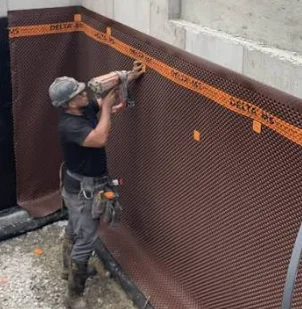
Positive-side geosynthetic linings are typically used as external coverings on the soil side of basement and tunnel structures, of filling faces and of retaining structures. These coverings prevent seepage before it can penetrate into the surrounding soil. Drainage geosynthetic composites on the other hand relieve the hydrostatic pressure in the soil by conveying the water away from the structure before it can come into contact with the membrane.
Roofs and Podium Decks
When designing a flat roof, particular attention should be paid to the roof’s slope to prevent standing water. Minimal ponding of water can cause the most damage through thermal cycles. In design of roof for podiums over occupied spaces, an Inverted Roof design allows for protection of insulation by roof wet area and covering with ballast. This design also provides easy maintenance access from below the main waterproofing layer without having to strip roofing.
Wet Interiors and Water-Retaining Structures
Internal waterproofing is required for areas such as bathrooms, swimming pools and tanks that are subject to permanent immersion or permeable vapor. These areas can be protected with cementitious coatings that are reinforced with polymers to form a hard, rigid and waterproof surface that is ideal for tiling. All joints must be sealed using tapes or injectable hydrophilic sealants which will expand when in contact with water.
How Does Climate Affect Waterproofing System Design?
Climate determines both the environmental loads and long-term behavior of the materials used in waterproofing systems.
Thermal Expansion Cycles
Many parts of the world experience large variations in temperature throughout the year. This causes building components to go through cycles of expansion and contraction. Because they are stretchy and can expand and contract with the temperature without cracking, elastomeric membranes are far better than cement-based coatings at withstanding such stresses.
Humidity Control in Tropical Zones
In tropical climates with high ambient humidity and rainfall intensity, vapor-permeable yet watertight membranes become essential. They allow trapped moisture within walls to escape outward while preventing external rainwater from entering—reducing mold growth risk inside conditioned spaces.
Freeze-Thaw Resistance in Cold Regions
In cold climates, materials must be able to resist damage from freeze-thaw action of water that has become trapped in the material. In laboratory testing, the modified bitumen sheets tested with polyester reinforcement showed excellent dimensional stability under these types of cyclic stress. The material performed much better than unmodified asphaltic materials.
What Role Does Detailing Play in System Integrity?
Advanced materials fail as soon as the detailing is not done correctly during design and/or construction.
Joint Treatment Techniques
A Joint is the weakest part of the system, concentrating local stresses that develop from even minor amounts of differential movement. Whether preformed Joint Tapes or liquid applied sealants are used, these components bridge the joints filling variable width expansion joints, maintaining full flexibility throughout.
Penetration Sealing Methods
Pipe entries, anchor bolts or conduit penetrations through slabs are common leak sites. Mechanical sleeves in conjunction with swellable waterstops form a redundant seal around any penetration thereby eliminating any capillary path for leakage.
Edge Terminations and Transitions
Junctions to parapets or wall floor etc require mechanical fixing and compatible joint seal to prevent peeling under negative pressure or settlement at corners.
How Is Quality Assurance Managed During Installation?
Verifying the quality of the installation at each stage through inspection protocols is essential to guarantee the design integrity of the building.
Surface Preparation Standards
Preparation of the substrate is key to successful adhesion. Ensure surfaces are clean, dry, even and ‘laitance’ free before application of primer. Moisture content testing of substrate must be undertaken to establish whether there is any residual moisture in the substrate that could undermine the bond between layers.
On-Site Testing Procedures
Outward field tests, like peel tests or flood testing, are performed before the subsequent covering layers are permanently installed. Any detected defects are repaired immediately and effectively using approved repair patches from the membrane manufacturer, not with common sealants that typically do not have matching elasticity.
Documentation and Maintenance Plans
All stages are fully documented. This includes product batch numbers, application environment, test results and photographs for all stages. Comprehensive and therefore forms a great traceable record of compliance for future maintenance planning or processing of warranty claims.
FAQ
Q1. What is the difference between a waterproofing system and a damp proofing system? A. Damp proofing systems are designed to prevent the diffusion of moisture whereas waterproofing systems resist the penetration of liquid water under hydrostatic pressure and also resist the vapor transmission under sustained load.
Q2. Which type of membrane is best suited for underground parking structures? A. Fully bonded sheet membranes are preferred as they prevent water to migrate laterally between the concrete substrate and the membrane even when localized penetrations occur during the service life of the system.
Q3. How frequently would you perform a roof waterproofing inspection? A. Annual, after heavy rainy seasons, for evidence of early deterioration such as the formation of blisters or separation of seams prior to water penetrations that would cause serious damage through structural failure requiring major repair.
Q4. Can one mix different products of different manufacturers within one system? A. Mixing is not recommended and only allowed after chemical compatibility testing was conducted to ensure stability of the mixture. After mixing, it is necessary to test for curing reactions in order to check for possible negative impact on adhesion at different interfaces.
Q5. How does green roofing affect waterproof layer performance? A. The performance of waterproof layers can be affected by green roofing in that root resistant barriers need to be installed above primary membranes. While bituminous membranes are resistant to penetration by roots in the long term, in the short term vegetated surfaces have the potential to leak beneath in areas where the roots have penetrated the membranes.